Fire Drill πŸ”₯

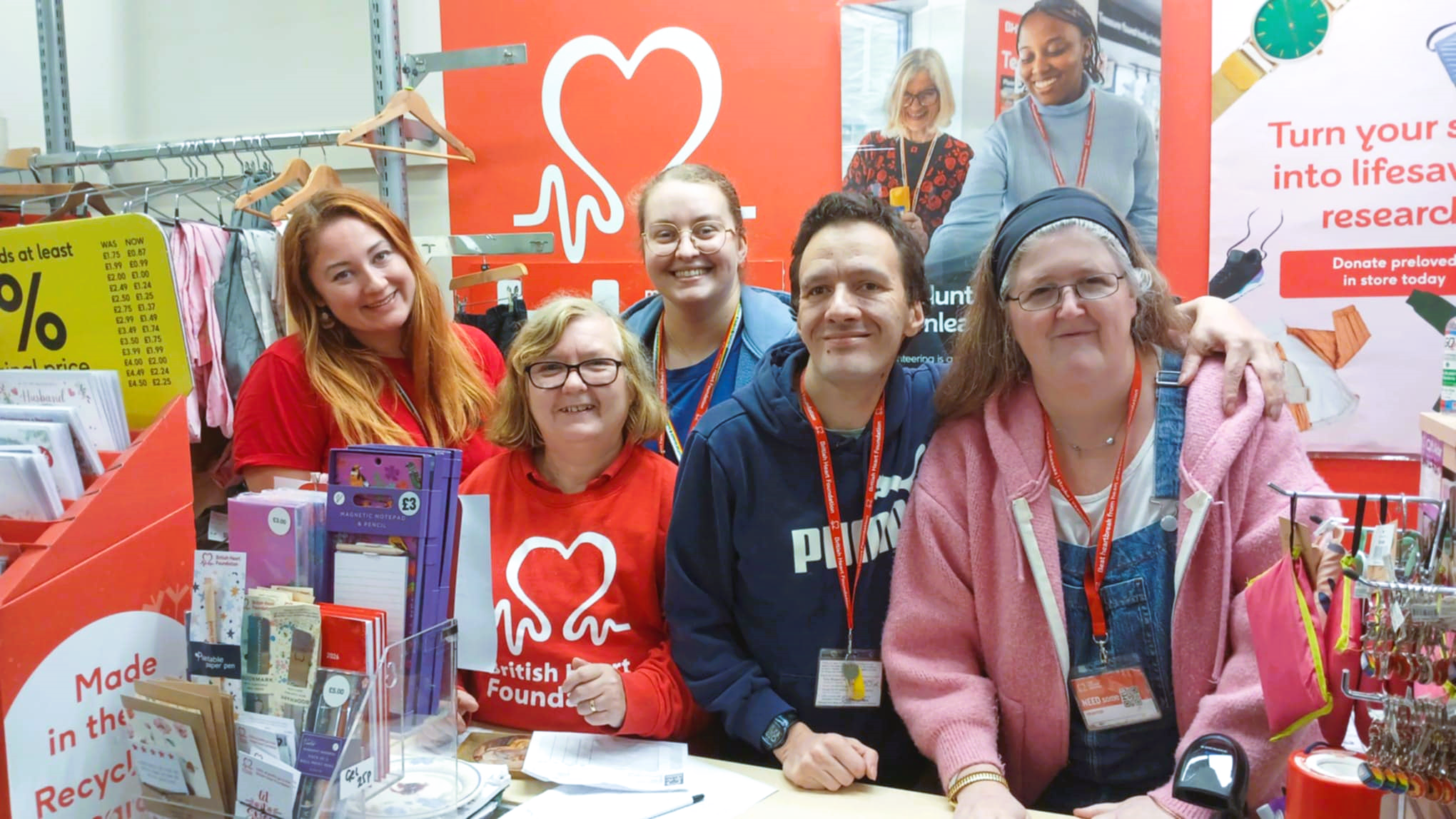
Today, we did a Fire Dill at work, which was fun. Read this post, if you have no idea what a Fire Drill is. We managed to evacuate the building in under 2 minutes, which is really good. Our customers were very cooperative and evacuated when the alarm sounded. Maria missed all the fun, as she came in late. However myself, Lucy, Bethan, Nigel, Kira and Anne, were all involved in the drill.

Thankfully, the weather wasn’t too bad, so we didn’t have to go to the assembly point in the pouring rain. However, Fires do not care if it is wet and dry… When the alarm sounds, it means evacuate, even if it’s wet!

Brown, Squidgy and Smelly

This afternoon, I had to deal with something rather nasty on the shop floor. I am not going to say what it is, but put it this way, it was squidgy, it was brown and it it smelt nasty. A pair of gloves, a carrier bag was what was needed. followed by the mop and bucket to wash the floor afterwards. This got me really angry, because it was caused by a 4 legged friend and the owner could not be bothered to clean up after their furry friend. I then also ended up banging my head on the shelves. I am OK, it was only minor, but it got reported anyway.

BIFFA Strike Again!

BIFFA are back in my bad books again, after blocking the fire exit again. I have taken a picture and sent it to Bethan. It clearly states by the gate, that it a fire exit, so BIFFA have no excuse to block it. Thankfully, I was able to shift the bins, before we did the Fire Drill. Either the Bin Men are blind or ignorant! (Or Both!)

The bin men should know better than to obstruct a fire exit. I was furious to find the fire exit blocked by the bins! If the bin men better not block the fire exit again, or I will shove my pricing gun where the light doesn’t shine!!!!! 😑😑😑🀬🀬🀬

Blowing in the Wind….

Finally, the bad weather has damaged the building. The roof of the bin compound has had it’s felt blown off. MSL are aware of this and should be coming to fix it, later this week.

Entertaining Day

Today at work has been fun, as it was only myself and Lucy in. Of course, we found ways to keep ourselves entertained, bouncing off each other with rubbish jokes and plenty of laughs. I spent most of the day on the shop floor and even may have convinced Lucy to dress up as Adele for Halloween. I even got asked by a customer, to come down in my high heels that I am going to wear with my Halloween costume. Of course, I didn’t mind parading round the shop in them. (That and a bit of Kenneth came out – OH MATRON!)

Once again, I left late, as I had a backlog of jobs to do before I left. – Hoover upstairs, wash up, clean the toilets, put the bins out and generally tidy up. However, I did manage to get the 5.30 bus, so that wasn’t too bad.

New Mug

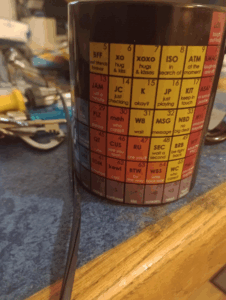
I grabbed this mug at the end of my shift. I payed a decent price for it, along with 2 bathroom mats. (Under a fiver) I love this mug, it has the Periodic Table of Text Messaging on it. This is a list of short codes used during texting. IE: WYL = Watch Your Language) It also has the codes for different similes. It is proper cool and I love it! πŸ™‚

I have had a few brews out of the mug. (Coffee, 3 sugars and very milky) Sadly, my bathroom mats are not a full set. It was missing the mat for around the toilet. This is why my boss sold it to me for a mere Β£2 for both mats. I may be able to get a mat that matches online. At least now I don’t have to stand on the cold Lino, when I get out the shower!

BTW, my Winifred Costume comes on Tuesday to work. I am going for the whole hog on Halloween, to be Winifred Sanderson (from Hocus Pocus) at work, this Halloween!

This week is going to be fun, as Maria is supposed to be off and Pat is off all week, so more than likely, I am going to be on the shop floor loads. I don’t mind, as that’s where all the action is. Our customers love me, as I am so entertaining and random. From my Fireman Sam (“Oooooh Boyo! Now then Norman, it’s not good to play with matches”) and Kenneth Williams Impressions, “(OOOOOH MATRON!”) To telling rubbish jokes (“Why can’t Dalmatians play hide and seek? Because they are always spotted”) and singing and dancing round the shop. Yes, I am nuts and proud of it!!! Just stand clear when I let out a loud fart on the shop floor! (Frrrrrrrrrrph – “More Tea Vicar?”) πŸ˜‚

A Guide to Fire Drills

In Commercial Premises, the law prescribes that we must carry our a full evacuation of the building regularly. Regulatory Reform (Fire Safety) Order 2005) These evacuations should happen at least ONCE every SIX MONTHS and should encompass the full evacuation of the building, to an external assembly point.Β  The reason for these drills, is to make sure everyone knows what to do, if the fire alarm does sound.

So, lets talk about the best practices in a fire drill.

Never Announce the Drill

Fire Drills should be kept a secret. Only those that need to know, should know when the alarm will sound. This is done to make sure that people do not ignore the alarm when it sounds. I know about the fire drill at work next week, because of my position. This is ‘need to know info.’

Don’t Make it Obvious

You don’t want to make the evacuation obvious. That is why it is important to activate the alarm from a point where there are lots of people. Activate the alarm the normal way, using a ‘break glass unit,’ either by activating the same way as you would when there is a fire, or using the test key. (Which goes into the bottom or side of the break glass unit)

Make Sure You Review Your PEEP Documents

IfΒ  you have disabled people, make sure that you have reviewed your Personal Evacuation Plans. (PEEPS) This will help you toΒ  plan the evacuation and allow you to ensure disabled people are evacuated safely.

Let Your ARC Know, If You Have A Monitored System)

If you have a monitored system, it is important to let your Alarm Monitoring Centre know you are carrying out an evacuation. This will prevent them from calling out the Fire Service. If you do not have a monitored system – you should ring the non emergency number for your local Fire Authority and let their control room know. You can normally find this number on the website for your local Fire Authority. It may also be a good idea to let neighbouring properties know, so they do not call 999.

Make Sure Your Fire Marshals Help To Clear The Building

Your Fire Marshalls should make sure that the building is fully evacuated. Those Evacuating, should stop what they are doing and be encouraged to leave their personal possessions where they are.Β  Evacuation should then be carried out via the nearest exit.

Proceed to the Assembly Point

Make sure everyone goes to the Assembly Point and make sure they stay there until the evacuation is stood down. It is a good idea to keep someone at a safe distance from the building, to make sure other people do not enter the building, until the evacuation is stood down. The Assembly Point, should be at a minimum of 50 feet away from the building.

Standing Down

The evacuation should be stood down, verbally. “Thank you, it is now safe to go back inside the building” is a example you can use. If like us, you use 2 way radios, make sure that you clearly state something along the lines of: “Fire Alarm Stand Down, I repeat… Fire Alarm Stand Down.” This lets everyone know that the incident is stood down and that it is safe to go back into the building.

Log in the Fire Alarm Log Book

Make sure that you log the evacuation in your Fire Alarm Log Book and let the ARC \ local Fire Authority know, the drill is complete.

What is the best achievable time to evacuate the building?

Ideally, the building should be fully evacuated within 2 minutes

Wet Wet Wet (And No, Not the Song)

The weather today has deffo been wet. On the way to the shop, I got soaked and had to borrow a pair of trackies from the stock room, as mine were soaked through. At the shop, I spent most of the morning on the shop floor. This was because of the rain. Our floor got absolutely drenched, by the customers coming in and out. So, I had my mop and bucket on standby and kept mopping the floor. Of course, I had the wet floor signs out, to warn people that the floor was slippy.

Then when the rain finally stopped, I was able to cover Maria on the till. That was a baptism of fire, as the till kept crashing. After several attempts (and after having to get Bethan and restart the till 3 times) the till finally started to work. Thankfully, Pat was coming on duty, so the till was no longer an issue for me. However, toilet checks were now over a hour past their due time, so I nipped up and had a quick brew, before going into toilet cleaning mode.

Thankfully, myself Maria, Bethan and Kira are quite clean, so the loos were not too bad. I almost missed the bus home, as I had to go back and take my lanyard back in. Can’t loose that, it has my locker key on it!!!!!

Tomorrow, I have the Health and Safety checks to do. – Emergency Lighting, Fire Fighting Equipment, making sure the exit routes are clear and of course the Fire Alarm Test. I am hopefully meeting up with my friend Chris at 1 and going to lunch. I don’t where though, but it will be good to have a catch up. Thankfully, I have my trusty radio, if I am needed in the meantime.Β  I have not seen Chris in years, so be good to catch up.

Another 40 mins and I will be taking Splodge round to Steph’s for a play, while we watch Shameless. πŸ™‚

Feeling Better

I am feeling better than I was yesterday. I have had 3 lots of the antibiotics, which is helping to get rid of the infection. I managed to go into the shop today and got quite a bit of sorting out done.

I decided to sort out the caddies that contain our stickers, tags and Gift Aid tags. In this caddy, there was all sorts. Pens, scissors, paperclips and all sorts of other bits and bobs. These all found new homes, especially the scissors, which are now on hooks on the workstations in the Sort Room. All the stickers are now stacked neatly, so it is easier to find things. Then I sorted the “Rags Bags” box. Rags are the clothes we cannot sell, for what ever reason. These get recycled and sent to Third World Countries. We have loads of rolls of these bags, so I stacked them neatly.

After lunch, I did a bit of work behind the till, serving customers, so that Maria could have a break. Then I did my usual cleaning duties before I left. Bethan wanted to know what the address was to the stream for my show, so I wrote that down for it. Because of the amount of pens that do not work, this took me a good 10 minutes! It meant that I was late leaving today. However, I got back for my show and played Bethan and the gang a song or 2.

UIT’s Suck!!!!

So I have a UTI at the moment. This is a Urinary Tract Infection. It has been caused by my catheter, which goes through the base of my belly. (Much better than up the other way) Trying to get a Doctors appointment is impossible these days.Β  I struggled at work and I managed to get a couple of jobs done, including a stock inventory of my cleaning supplies and cleaning the toilets. However, by 12m the pain was really bad and I really felt unwell, so I had to cave in and tell Lucy that I am not well enough to continue and had to go home sick.

I went up to Urgent Care at the Hospital to get seen and had my urine dipped. No surprise, it is full of bugs, so guess what? I am back on Antibiotics. πŸ™

Hopefully tomorrow, I might feel a bit better and in less pain. I hope so, because I love my job and hate being off sick. Keep your fingers crossed. πŸ™‚

How Does a Fire Alarm System Work?

A Fire Alarm System in any business premises, is a valuable and vital bit of kit. It keeps us, our equipment and our stock safe. But how does it work? In this article, we shall delve in and find out.

A Diagram of A Fire Alarm System

This is a basic setup. There are 2 zones (areas that are monitored) and each has a call point and a bell, as well as a smoke detector. The system is wired in a continual loop, which is then fed back to the Control Panel.

Fire Alarm Panel

The Control Panel is the brains of the operation and keeps an eye on the system and it’s functions. It has several indicators, to show the location of a fire, the location of any system faults, zones that may have been disabled and have controls to silence and reset the system, among others. controls the system’s functions, and they can be programmed using software provided by the manufacturer or, in some cases, through the front panel buttons.Β 

It contains a motherboard, with integrated memory and a microprocessor. The Board has connectors for each device. This is usually via a terminal block at either end of the board. This is soldered connected to the motherboard The Fire Alarm Panel will normally run it’s own software, which controls the board. This software is essential for tasks like programming devices, managing zones, and displaying alerts, allowing the control panel to identify the exact location of an alarm or fault.

The system may have been setup to prevent unauthorised use of the programming and other controls. This may be a key, a combination of buttons, (which are used as a pass-code) or both. On many systems, you will need to access the ‘Supervisor Mode’, before you can silence and reset the alarm.

Addressable Systems

In more complex systems, such as in offices or hotels, the system may be addressable. This will show the exact location of the suspected fire and which device has been activated. For instance, Zone 2 – Kitchen (Smoke Detector Activated) This makes it easier to locate where the alarm has been activated from and allows investigations to be carried out, to determine if the fire is real or if it has been activated for other reasons. (IE: Steam)

Pre-Alarm Circuit

On systems in hotels and offices, the system often has Pre-Alarm Circuit. When the alarm is activated, it will not sound the alarm throughout the building. (This prevents unnecessary evacuation) Instead, it will either activate a single bell, (for instance, in reception) or will make a buzzer sound on the control panel. (In a CCTV Control Room) Either way, the red light for the corresponding zone will flash on the control panel, to indicate where the alarm is sounding from. As mentioned above, on addressable systems, the system will show which device has been activated and it’s location.

On some systems, Pre-Alarm will only activate the bells \ sounders in the zone of origin, as well as on the Control Panel. The system can also be programmed to send a text or paging message, depending on the setup. (This is only usually the case in very large buildings, such as Hospitals or very large Office Blocks.)

Pre-alarm will initiate a countdown, which will allow staff time to investigate the reason for the alarm going off. This allows them to locate the equipment activated and determine if it is a false alarm and reset the system if needed. This timer can be anywhere from 2 minutes up to 5 minutes. Once the countdown timer reaches zero, the system will go into ‘full alarm state’ and sound the alarm throughout the building.

If a fire is found, full alarm can be activated, by smashing the glass on a call point. This will stop the countdown and immediately sound the put the system into alarm state. The alarm can also be activated from the main control panel, by accessing supervisor mode and then pressing the Evacuate button. (On some systems, this button is named Sounders \ Off. however, it does the same thing)

Powering the System

The Fire Alarm System is wired into it’s own circuit on the building’s electrical system and should have it’s have it’s circuit breaker on the main Distribution Panel. It will also have it’s own connector to the mains, which does not have a switch. However, some systems have a key switch, which allows the mains power to the panel to be isolated. In general terms, the power should never be disconnected.

The system should have a battery backup, to allow the system to continue to operate during power outages. On smaller scale systems, this is a internal battery, similar to a car battery, but on a smaller scale. Alternatively, the system may have it’s own uninhabitable power supply, Often this is located near the fire alarm panel and is normally a white box, with a green light. (This indicates that the battery is charging)

In larger buildings, such as Hospitals, the generators will power the system.

What happens if I disconnect the Smoke Detector Head?

The Control Panel would flash fault and display the zone \ location, if you disconnected a Smoke Detector Head. On addressable systems, it would show the exact room that the fault is in. It is important never to disconnect or cover a smoke detector head. It is there to save your life! Additionally, you could get into trouble, for fiddling with the system.

So How Does It Work?

Now lets look at how it works.

Scenario 1: Smoke Detectors

Smoke Detector

In this scenario, Leslie has left a heater on in zone 2. Near to the heater, is a tea towel that is hung on a rack. The tea towel falls off the rack, lands on the heater and begins to smoulder. Very quickly, the situation escalates and a fire breaks out. Smoke quickly begins to fill the room, which the smoke detector detects. This is through a beam that is in the smoke detector. The smoke is thicker than air and is what will break the beam.

This causes a break in continuity in the circuit and sends a SOS message to the control panel.

The Control Panel will know where the fire has been detected from and will then send a message to the bells, making them start to ring. – Thus alerting people in the building there is a fire. On the control panel, a buzzer will sound and a red light will flash in the fire zone, where the alarm has been activated from. Now Leslie knows there is a fire in Zone 2, which is upstairs.

Scenario 2: Heat Detector

Heat Detector

In this scenario, Leslie has left a heater on in zone 2. Near to the heater, is a tea towel that is hung on a rack. The tea towel falls off the rack, lands on the heater and begins to smoulder. Very quickly, the situation escalates and a fire breaks out. The heat from the fire, activates the heat alarm, This causes a break in continuity in the circuit and sends a SOS message to the control panel.

Heat Detectors, use a thermistor, bimetallic strip. The alarm will go off, when the heat rises above a certain temperature. (Usually above 95c.)

Scenario 3: Call Points (Also known as Break Glass Units)

Break Glass Unit

Leslie is making something to eat in the microwave. However, the microwave is faulty and bursts into flames. Leslie goes to the nearest Fire Alarm Call Point and breaks the glass. This causes a break in continuity in the circuit, thus sending another SOS Message to the control panel. This also causes the alarm to sound and zone 2 to flash on the control panel.

On older units, there was a glass panel, which had to be broken,Β  to press the button. Break glass units on systems built before 1990, had a little hammer connected to it by a chain, which you can use the break the glass. However, after 1990, this changed. You need to only use your finger to press hard on the glass.

Other Components

Repeater Panels

In larger buildings, like Government Offices and Hospitals, there may be repeater panels. These panels act like the main control panel and may be able to silence and reset the alarm. However, they are designed so that you do not need to walk to the main control panel, which could be several floors down. It allows Fire Marshall’s on the floor in question, to see where the alarm has been activated from. These panels may be in a stairwell or by the Nurses Station.

Autodiallers

In many buildings, (including ours) the alarm is connected to a autodialler, which will dial out, when the alarm is activated. Years ago, these were linked to the Fire And Rescue Dispatch Centres and would send the Fire Brigade automatically. These days, systems are typically connected to an Alarm Receiving Centre, also known as a ARC. The ARC, will receive a notification that the fire alarm has been activated and they will then phone to see if the alarm is genuine or not. If the alarm is genuine, they will arrange for Fire and Rescue to attend. If not, they will close the call down on their systems. This was designed to lower the amount of false alarms and prevent unnecessary Fire and Rescue attendances.

There is one exception to this and that is in Hospitals. Hospitals have lots and lots of people in them and makes evacuation very hard. Hospitals do have horizontal and vertical evacuation procedures in place, but this is outside the scope of this post. In the event of a fire, the fire alarm system in a Hospital will always send a message to Fire and Rescue and will cause a priority alert to be shown on their screen. This is why you will quite quickly see fire engines turn up, if you have been in hospital and heard the fire alarm go off.

Alarm Beacons & Paging Systems

Alarm Beacons will flash, when the alarm activates. This is vital for those that are deaf and cannot hear the alarm. Paging Systems can send a pager message or a text message to a deaf building user,Β  alerting them of a fire.

Door Closers

Automated Door Closers, are wired to the system. These are held open by a magnet, which de-energises, when the alarm goes off.This helps to stop the fire and smoke from spreading.

Automatic Shutdown

In buildings that have Air Conditioning and Ventilation Systems, an auto shutdown will automatically switch these systems off. Again, this helps to stop the fire spreading.

Sprinklers

Fire Alarm Systems are often linked to the sprinkler system. This can be either a water based or C02 based system. It also will have it’s own controller linked to the fire alarm system. However, this is outside the scope of this article.

So that is how a Fire Alarm System works. I hope you found my post interesting.


I’m A Bit Of A BHF Celeb! :)

I am a bit of a celeb with the local Managers at the BHF. As mentioned in my previous post, Bethan was going to send a picture of what I have been doing to the Area Manager. Our Area Manager has taken it one step further and sent it to all the Shop Managers in the area, who are really impressed with what I have been doing. πŸ™‚ My organising projects have made me a bit of a local celeb in the world of BHF, because I work hard to make sure everyone remains safe and that our store looks it’s best.

It is no fault of anyone, but when I came to the local shop, it was in a state. (Especially the toilet, that had walls covered in cobwebs) and the lino on the shop floor was very neglected. If you have come into our shop, you will see that I am often down on the shop floor and I am constantly sweeping, spray mopping and dusting.

It’s nice to know I am appreciated πŸ™‚

I also finally got my QR Code, which now means I can login to the EPOS System on the Shop Floor. (I don’t have to get anyone to login for me now and I can actually serve customers, under my own login!)