A Fire Alarm System in any business premises, is a valuable and vital bit of kit. It keeps us, our equipment and our stock safe. But how does it work? In this article, we shall delve in and find out.
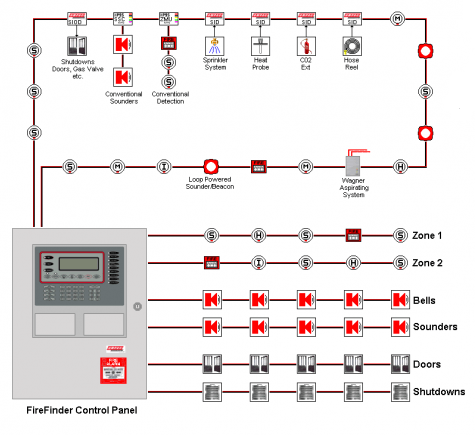
This is a basic setup. There are 2 zones (areas that are monitored) and each has a call point and a bell, as well as a smoke detector. The system is wired in a continual loop, which is then fed back to the Control Panel.
Fire Alarm Panel
The Control Panel is the brains of the operation and keeps an eye on the system and it’s functions. It has several indicators, to show the location of a fire, the location of any system faults, zones that may have been disabled and have controls to silence and reset the system, among others. controls the system’s functions, and they can be programmed using software provided by the manufacturer or, in some cases, through the front panel buttons.
It contains a motherboard, with integrated memory and a microprocessor. The Board has connectors for each device. This is usually via a terminal block at either end of the board. This is soldered connected to the motherboard The Fire Alarm Panel will normally run it’s own software, which controls the board. This software is essential for tasks like programming devices, managing zones, and displaying alerts, allowing the control panel to identify the exact location of an alarm or fault.
The system may have been setup to prevent unauthorised use of the programming and other controls. This may be a key, a combination of buttons, (which are used as a pass-code) or both. On many systems, you will need to access the ‘Supervisor Mode’, before you can silence and reset the alarm.
Addressable Systems
In more complex systems, such as in offices or hotels, the system may be addressable. This will show the exact location of the suspected fire and which device has been activated. For instance, Zone 2 – Kitchen (Smoke Detector Activated) This makes it easier to locate where the alarm has been activated from and allows investigations to be carried out, to determine if the fire is real or if it has been activated for other reasons. (IE: Steam)
Pre-Alarm Circuit
On systems in hotels and offices, the system often has Pre-Alarm Circuit. When the alarm is activated, it will not sound the alarm throughout the building. (This prevents unnecessary evacuation) Instead, it will either activate a single bell, (for instance, in reception) or will make a buzzer sound on the control panel. (In a CCTV Control Room) Either way, the red light for the corresponding zone will flash on the control panel, to indicate where the alarm is sounding from. As mentioned above, on addressable systems, the system will show which device has been activated and it’s location.
On some systems, Pre-Alarm will only activate the bells \ sounders in the zone of origin, as well as on the Control Panel. The system can also be programmed to send a text or paging message, depending on the setup. (This is only usually the case in very large buildings, such as Hospitals or very large Office Blocks.)
Pre-alarm will initiate a countdown, which will allow staff time to investigate the reason for the alarm going off. This allows them to locate the equipment activated and determine if it is a false alarm and reset the system if needed. This timer can be anywhere from 2 minutes up to 5 minutes. Once the countdown timer reaches zero, the system will go into ‘full alarm state’ and sound the alarm throughout the building.
If a fire is found, full alarm can be activated, by smashing the glass on a call point. This will stop the countdown and immediately sound the put the system into alarm state. The alarm can also be activated from the main control panel, by accessing supervisor mode and then pressing the Evacuate button. (On some systems, this button is named Sounders \ Off. however, it does the same thing)
Powering the System
The Fire Alarm System is wired into it’s own circuit on the building’s electrical system and should have it’s have it’s circuit breaker on the main Distribution Panel. It will also have it’s own connector to the mains, which does not have a switch. However, some systems have a key switch, which allows the mains power to the panel to be isolated. In general terms, the power should never be disconnected.
The system should have a battery backup, to allow the system to continue to operate during power outages. On smaller scale systems, this is a internal battery, similar to a car battery, but on a smaller scale. Alternatively, the system may have it’s own uninhabitable power supply, Often this is located near the fire alarm panel and is normally a white box, with a green light. (This indicates that the battery is charging)
In larger buildings, such as Hospitals, the generators will power the system.
What happens if I disconnect the Smoke Detector Head?
The Control Panel would flash fault and display the zone \ location, if you disconnected a Smoke Detector Head. On addressable systems, it would show the exact room that the fault is in. It is important never to disconnect or cover a smoke detector head. It is there to save your life! Additionally, you could get into trouble, for fiddling with the system.
So How Does It Work?
Now lets look at how it works.
Scenario 1: Smoke Detectors
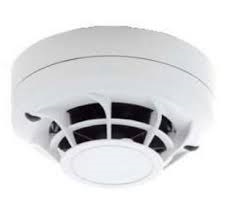
In this scenario, Leslie has left a heater on in zone 2. Near to the heater, is a tea towel that is hung on a rack. The tea towel falls off the rack, lands on the heater and begins to smoulder. Very quickly, the situation escalates and a fire breaks out. Smoke quickly begins to fill the room, which the smoke detector detects. This is through a beam that is in the smoke detector. The smoke is thicker than air and is what will break the beam.
This causes a break in continuity in the circuit and sends a SOS message to the control panel.
The Control Panel will know where the fire has been detected from and will then send a message to the bells, making them start to ring. – Thus alerting people in the building there is a fire. On the control panel, a buzzer will sound and a red light will flash in the fire zone, where the alarm has been activated from. Now Leslie knows there is a fire in Zone 2, which is upstairs.
Scenario 2: Heat Detector
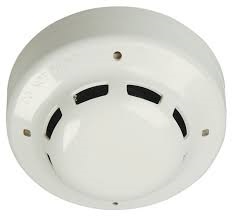
In this scenario, Leslie has left a heater on in zone 2. Near to the heater, is a tea towel that is hung on a rack. The tea towel falls off the rack, lands on the heater and begins to smoulder. Very quickly, the situation escalates and a fire breaks out. The heat from the fire, activates the heat alarm, This causes a break in continuity in the circuit and sends a SOS message to the control panel.
Heat Detectors, use a thermistor, bimetallic strip. The alarm will go off, when the heat rises above a certain temperature. (Usually above 95c.)
Scenario 3: Call Points (Also known as Break Glass Units)
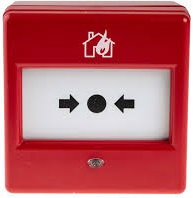
Leslie is making something to eat in the microwave. However, the microwave is faulty and bursts into flames. Leslie goes to the nearest Fire Alarm Call Point and breaks the glass. This causes a break in continuity in the circuit, thus sending another SOS Message to the control panel. This also causes the alarm to sound and zone 2 to flash on the control panel.
On older units, there was a glass panel, which had to be broken, to press the button. Break glass units on systems built before 1990, had a little hammer connected to it by a chain, which you can use the break the glass. However, after 1990, this changed. You need to only use your finger to press hard on the glass.
Other Components
Repeater Panels
In larger buildings, like Government Offices and Hospitals, there may be repeater panels. These panels act like the main control panel and may be able to silence and reset the alarm. However, they are designed so that you do not need to walk to the main control panel, which could be several floors down. It allows Fire Marshall’s on the floor in question, to see where the alarm has been activated from. These panels may be in a stairwell or by the Nurses Station.
Autodiallers
In many buildings, (including ours) the alarm is connected to a autodialler, which will dial out, when the alarm is activated. Years ago, these were linked to the Fire And Rescue Dispatch Centres and would send the Fire Brigade automatically. These days, systems are typically connected to an Alarm Receiving Centre, also known as a ARC. The ARC, will receive a notification that the fire alarm has been activated and they will then phone to see if the alarm is genuine or not. If the alarm is genuine, they will arrange for Fire and Rescue to attend. If not, they will close the call down on their systems. This was designed to lower the amount of false alarms and prevent unnecessary Fire and Rescue attendances.
There is one exception to this and that is in Hospitals. Hospitals have lots and lots of people in them and makes evacuation very hard. Hospitals do have horizontal and vertical evacuation procedures in place, but this is outside the scope of this post. In the event of a fire, the fire alarm system in a Hospital will always send a message to Fire and Rescue and will cause a priority alert to be shown on their screen. This is why you will quite quickly see fire engines turn up, if you have been in hospital and heard the fire alarm go off.
Alarm Beacons & Paging Systems
Alarm Beacons will flash, when the alarm activates. This is vital for those that are deaf and cannot hear the alarm. Paging Systems can send a pager message or a text message to a deaf building user, alerting them of a fire.
Door Closers
Automated Door Closers, are wired to the system. These are held open by a magnet, which de-energises, when the alarm goes off.This helps to stop the fire and smoke from spreading.
Automatic Shutdown
In buildings that have Air Conditioning and Ventilation Systems, an auto shutdown will automatically switch these systems off. Again, this helps to stop the fire spreading.
Sprinklers
Fire Alarm Systems are often linked to the sprinkler system. This can be either a water based or C02 based system. It also will have it’s own controller linked to the fire alarm system. However, this is outside the scope of this article.
So that is how a Fire Alarm System works. I hope you found my post interesting.